SITREP
- 3.1
- Rating
- 10.00K
- Installs
- Free
- Price

 Analysis by App-foxy
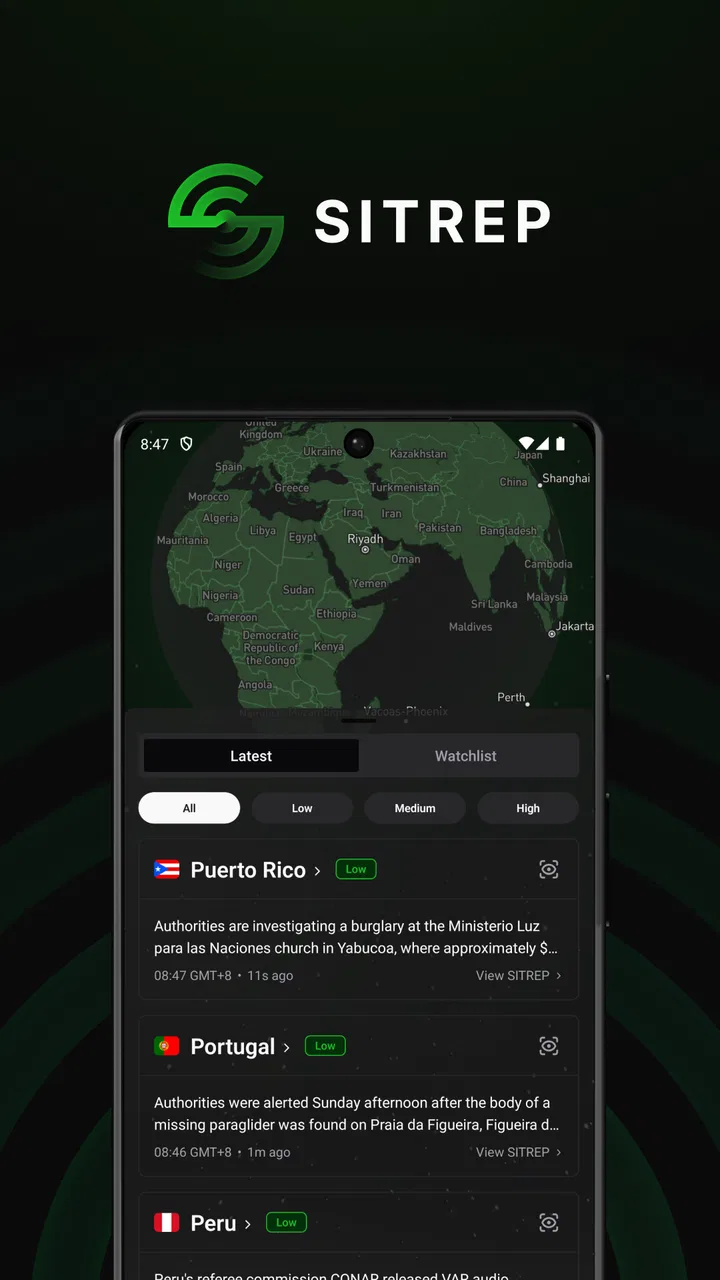
I approached SITREP as a compact news and magazines app for people who want a quick view of developing events rather than a long reading session. Its focus is real-time global intelligence and alerts, which gives it a more urgent feel than a conventional newspaper reader. I found the idea useful when I wanted to check what might matter now, but it also demands a more careful reading habit because alerts are most valuable when I understand their context instead of reacting to every notification.
The app comes from Artorias, Inc. and is free to download, with optional in-app purchases priced at $9.99 per item. It is rated for Everyone, so its intended audience is broad. At the time of my review, the current release is version 1.0.5, and the app requires at least iOS or Android 11. That operating-system requirement is worth checking before installing, especially if you are using an older phone or tablet.
How I used SITREP as a daily intelligence check
My most practical routine was simple: open the app at the start of the day, scan the most relevant developments, and return later only when an alert appeared connected to something I was already following. That approach worked better than leaving the app open constantly. SITREP makes more sense as a focused checkpoint than as a replacement for every source of news on my phone.
You May Also Like

 AccuWeather: Weather Radar
AccuWeather Review: A Quick, Clear Forecast for Everyday Decisions
For everyday plans, the best forecast is the one you can understand quickly. AccuWeather makes rain timing, radar, and local conditions easy to act on, with a few trade-offs.

 Hill Climb Racing
Why Hill Climb Racing Still Turns Crashes Into One More Run
A tiny car, a bumpy hill and one more upgrade: Hill Climb Racing keeps resurfacing because its simple chaos makes every near-miss feel personal.

 AliExpress - Shopping App
AliExpress Makes Global Shopping Feel Personal, but Shoppers Bear the Risk
AliExpress turns a global marketplace into a pocket-sized discovery engine. Its reach is useful, its shopping loop compelling, and its trade-offs easy to miss.

 Lords Mobile: Kingdom Wars
Lords Mobile Is a Kingdom-Building Routine, Not a Quick Match
A case-by-case verdict on the building, battles, device demands, and social commitments that make Lords Mobile rewarding for some players and exhausting for others.

 PDF Scanner app - TapScanner
TapScanner Makes Paperwork Easier to Capture, Check, and Share
TapScanner makes scanning with a phone feel less like a rescue operation and more like a dependable step in getting work done. Its capture tools are useful, though not flawless.

 Block Blast!
 Shows How Much a Puzzle Game Can Leave Out
A quiet grid game shows why puzzle players increasingly value instant clarity, repeatable skill and low-pressure play—and where the genre still needs to catch up.
More From Our News Desk
View All News


The distinction matters. A traditional newspaper app usually gives me a structured front page, detailed sections, opinion pieces, and a clear editorial rhythm. A general news aggregator gives me breadth, but often mixes major stories with items selected mainly because they are popular. SITREP feels aimed at the space between those two habits: quick awareness of significant developments, with alerts acting as prompts to investigate further.
I would use it before commuting, during a short break, or when I need to know whether a major international story has changed. I would not rely on a glance at an alert as my complete understanding of a complicated event. The strongest workflow is to treat the notification as a signal, then read enough surrounding material to understand what happened, where it happened, and why it may matter.
That is also the first important trade-off. Real-time information can be useful precisely because it arrives quickly, but speed can make incomplete information feel more definitive than it is. I found SITREP more helpful when I used it to identify topics for follow-up, not when I expected every update to provide a finished explanation.
Who gets the most value from the app
SITREP should appeal to readers who follow international events, security developments, emergencies, or fast-moving stories and prefer a concise starting point. It may also suit someone who dislikes scrolling through a large social feed just to find the few developments that deserve attention. The alert-oriented approach can reduce that searching, provided notifications are kept under control.
It is less suitable for a reader who wants a complete newspaper experience in one place. If your priority is entertainment news, lifestyle coverage, extensive local reporting, or long-form analysis, a specialist publication may serve you better. Likewise, anyone who prefers to read only at a fixed time may gain little from a real-time alert model.
One realistic example is a person preparing for a workday involving international clients. Instead of checking several unrelated feeds, that user could make SITREP part of a short morning routine, note the developments relevant to those clients, and then move to a trusted detailed source for background. The benefit is not that the app eliminates research; it helps decide where research should begin.
Settings I would check before relying on alerts
The first setting I would review is notification behavior. An alert app can become tiring if every update receives the same level of attention. I would begin conservatively, keep only the notifications that support a real need, and avoid treating an audible or visible alert as proof that the story is immediately actionable.
I would also check the app’s general presentation preferences and any available controls for how information is displayed. The useful question is not “How do I see everything?” but “What do I need to see quickly, and what can wait until I open the app?” That distinction turns a stream of interruptions into a deliberate information routine.
Because SITREP is still a relatively early product, I would spend a few minutes learning its navigation rather than assuming it behaves exactly like a familiar newspaper app. The current version may feel straightforward to one person and less polished to another, particularly if they expect highly refined filtering or a deeply customizable news dashboard.
I would also consider the purchase model before building a long-term habit. The basic app is free, while optional purchases cost $9.99 per item. That does not automatically make the free experience inadequate, but it does mean I would first use the no-cost version long enough to understand which parts of the workflow I actually value. Buying before finding a regular use case would be unnecessary.
Small habits that make the alerts more useful
My favorite practical habit was separating “notice” from “investigate.” When an alert arrived, I first asked whether it affected something I was tracking. If the answer was no, I did not let it interrupt the rest of my day. If the answer was yes, I opened the app and looked for the surrounding context before forming an opinion.
A second useful pattern is to keep a short list of topics in mind before opening SITREP. That list might include a region, an industry, or an ongoing situation. With a question already in mind, a quick scan becomes more purposeful. Without one, it is easy to move from one urgent-looking item to another and finish without knowing what was actually important.
I also found value in pairing the app with a slower source. SITREP can be the early-warning layer, while a newspaper, broadcaster, or specialist publication supplies chronology and explanation. This combination is more reliable than expecting a fast alert service to provide every detail in the same moment.
For people who check news repeatedly, a scheduled routine may be better than constant monitoring. I would check once in the morning and again later if the subject genuinely affects my work or personal plans. That reduces notification fatigue and makes changes easier to notice because I am comparing meaningful checkpoints rather than reacting to every small update.
Where it differs from ordinary news alternatives
Compared with a general news aggregator, SITREP’s appeal is its emphasis on intelligence-style awareness and alerts. A broad aggregator may expose me to more publications and a wider mix of subjects, but that breadth can also create noise. SITREP feels more purposeful when I want to know whether something significant is developing.
Compared with a single newspaper app, it offers a different reading philosophy. A newspaper usually asks me to browse a publication’s complete editorial package. SITREP is more useful when I want a rapid status check and am willing to continue elsewhere for depth. Neither approach is universally better; the right choice depends on whether speed or narrative completeness comes first.
Compared with social media, I found the alert model less dependent on an endless feed, which is a meaningful advantage for anyone trying to avoid unrelated content. Social platforms may surface eyewitness material quickly, but they also demand more effort to judge relevance and reliability. SITREP is easier to use as a first filter, although I would still verify important claims through established reporting.
That comparison also explains why I would not install it as my only news source. Its role is clearest as a monitoring tool. If I want a broad cultural overview, local reporting, detailed investigations, or a strong editorial voice, I would add another app rather than asking SITREP to cover all of those jobs.
Limits that experienced users should understand
The average rating of 3.1 from around 123 ratings suggests that user reactions are mixed, and my experience helps explain why that may happen. The concept is focused, but a focused concept can feel limited if a reader expects the depth and customization of a mature news platform. Someone looking for a fully developed personal news command center may find the experience too narrow.
The app has received around 35 written reviews, and that is still a modest amount of public feedback for judging how it will fit every device and reading style. I would therefore approach it with realistic expectations: useful for testing a particular alert workflow, but not something I would choose solely because I expect a long-established ecosystem.
Another limitation is interpretive rather than technical. A fast global alert can tell me that something deserves attention, but it cannot replace judgment. If I am making a business decision, discussing a sensitive event, or sharing information with other people, I would open the underlying details and compare the report with a dependable secondary source.
There is also a personal-cost limit. If alerts make me anxious or repeatedly break concentration, the app is working against me even when the information is relevant. In that situation, a scheduled newspaper briefing or a manually controlled RSS-style reader would be a better choice. Real-time access is valuable only when it improves awareness without taking over the day.
Questions I would answer before installing
Is SITREP free to try? Yes. The app itself is free, although optional in-app purchases are available at $9.99 per item. I would start without purchasing anything, establish whether the alerts and reading flow fit my routine, and only then decide whether an extra purchase is worthwhile.
Will it work on an older device? The minimum operating-system requirement is version 11, so I would check the phone or tablet before downloading. This is especially important for people who keep older devices as secondary news screens or emergency-use phones.
Is it appropriate for younger users? Its content rating is Everyone, which makes it broadly accessible. Even so, global intelligence and breaking events can involve difficult subjects, so parents may still prefer to discuss what children encounter and how alerts should be interpreted.
Can it replace a newspaper subscription or a general news reader? In my view, no. It can complement those services by providing a quicker awareness layer, but it is not the best single destination for long-form reporting, local coverage, or a complete daily edition.
Should I leave every alert enabled? I would not. The better approach is to begin with a restrained notification setup, observe which alerts genuinely change what I do, and reduce anything that creates noise. That simple adjustment made the app feel more useful and less demanding.
My verdict after settling into a repeatable workflow
After using SITREP as a deliberate monitoring tool, I see a clear audience for it. It is a good fit for someone who wants a fast global-awareness layer, values timely prompts, and is comfortable following important stories through additional sources. Its strongest quality is not replacing every news habit; it is helping me decide when a developing subject deserves attention.
I would recommend trying it if you regularly follow international developments and want something more focused than a social feed. I would skip it if you mainly want local journalism, deep analysis, entertainment coverage, or a quiet reading experience with no interruptions. In those cases, a conventional publication app or a manually controlled reader is likely to feel more natural.
The best way to use SITREP is as an alert-to-context system, not as a substitute for judgment. Keep notifications selective, check the app with a question in mind, and verify consequential stories through fuller reporting. Used that way, the free app from Artorias, Inc. has a practical place in a news routine, even though its early-stage feel and limited scope may not satisfy everyone.
My final recommendation is cautious but positive. SITREP is worth testing for its specific real-time purpose, particularly if you want a quick signal about global developments. I would give it time to prove that it improves your routine before paying for optional items, and I would keep a deeper news source alongside it. That combination makes its strengths clearer while keeping its limitations manageable.
FAQs for SITREP
01What is SITREP and what is it used for?
SITREP is designed to provide situation reports and organized updates in a clear, easy-to-follow format. It can be useful for users who need to monitor events, share operational information, or keep track of changing circumstances. Before downloading, remember that the exact tools and intended audience may vary depending on the version and platform available.
02Is SITREP suitable for personal use or only for professional teams?
SITREP may be useful for both individuals and teams, depending on how you plan to use its reporting and information-management features. It is particularly relevant for users who need structured updates, but casual users should review the app description carefully to confirm that it matches their needs. Some functions may be more valuable in organizational or professional environments.
03Does SITREP require an internet connection to work?
Many situation-reporting applications depend on an internet connection to retrieve current information, synchronize updates, or send reports to other users. Some content may remain available offline, but this should not be assumed for every feature. If you expect to use SITREP while traveling or in areas with limited connectivity, check its offline capabilities and synchronization behavior before relying on it.
04Is SITREP free to download, and are there any additional costs?
SITREP may be available as a free download, but the total cost can depend on the platform, account type, subscriptions, or features offered through in-app purchases. Availability and pricing can also change over time. Before installing, review the official store listing for current details about premium tools, recurring charges, advertising, and any requirements for professional or organizational access.
05What privacy and security considerations should I know before using SITREP?
Because SITREP can involve reports, locations, event details, or other potentially sensitive information, privacy should be considered before use. Review the permissions requested during installation and read the developer’s privacy policy to understand what data may be collected, stored, or shared. Avoid entering confidential information unless you are satisfied with the app’s security practices and account protections.
Pros
- Quickly delivers concise updates on military and security developments.
- Covers global events from multiple regions in one app.
- Useful for readers who prefer brief
- information-focused reporting.
- Regular updates help users follow rapidly changing situations.
- Simple format makes important headlines easy to scan.
Cons
- Some reports may reflect limited or developing information.
- The military focus may feel too narrow for general news readers.
- Frequent updates can make the feed feel repetitive over time.
- Complex events may lack the context provided by long-form analysis.
- Content may be unsettling for users sensitive to conflict-related news.

SITREP
Gallery